Πέμπτη, 19 Ιανουαρίου 2012

2012 event In the island of the Apocalypse


The fertile grounds of Urania's Gardens are sprouting this year 2012 in Patmos. A meeting of artists and curators is being set for July, in Maria Pesmazoglou's studio Art4View, which is situated near the Cave of the Apocalypse, for the branching in different possibilities and the foundation of an international art association.

Πέμπτη, 22 Δεκεμβρίου 2011

Newton's notes in ancient Greek

http://cudl.lib.cam.ac.uk/view/MS-ADD-03996/9
18-Cambridge Digital Library - University of Cambridge-ΧΙΙ

Newton's notes in ancient Greek from his Trinity College Notebook

used from c.1661-c.1665, photographed in 2011, located in Cambridge University Library UK.


Πέμπτη, 15 Δεκεμβρίου 2011

Τετάρτη, 29 Ιουνίου 2011

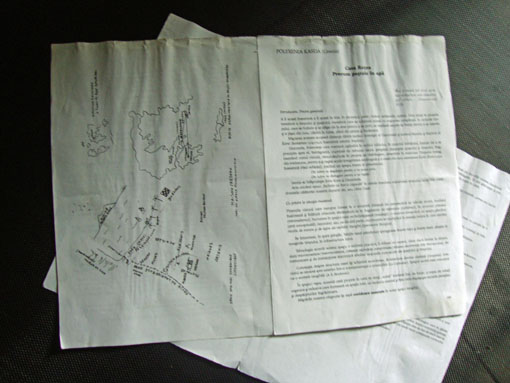
Concept of the Treasure hunt PAI 2011, by Polyxene Kasda

Treasure hunt cultural game Illustrations by Antonis Papantoniou/ Vim Viva
 
Tinkering with the Riddler's 'dark' fragments in the primordial landscapes of Samothrace
"Although the map was false, the treasure was real" Odysseas Papantoniou (6years old)

To be and not to be, this is the question
In the same rivers we enter and we do not enter, we are and are not” (Heraclitus, fg.49a) 
The Game of the Hidden Treasure, on the Island of the Winds, is based on a deck of cards illustrated with the sites of the island to be discovered, while tuned to Heraclitus' antinomic fragments, that exert an immediate impact on our internal structure, that transcends common understanding. “What I understood is outstanding and what I did not understand is outstanding as well “ commented Socrates on the Riddler's centauric fragments, that throw us out of our conceptual bed and lead to 'awakening'.The object is perceived as a visible expression of the universal, waving us in the unified hyperspace that embraces the 'unexamined' sleepers' private space, while we look for the treasure; the PAI 'Lapis Exilis', hidden in the flanks of the Moon, as Mount Saos is called and in the depths of our soul.
The Walkers discover the sites on the map, through social intercourse with the locals and “listening to nature”(112), they install themselves in the complex of signs of the 'true nature” of this island, “which likes to hide”(123), feeling the 'evarestissis'; the pleasure of “God that transmutes like fire, which when mingled with incenses, is named according to the perfume of each”. (67). On their way to the infinite limits of their soul (45), they discover maddening fragments of the Cabirian mosaic related to Sacred Conjunction and “Fire with which everything is exchanged” (90). Sensitive information is blinking in the mythological/ linguistic spectrum of the Island of the Gods, where, “Mortals/ Immortals, Immortal/ Mortals interchange, one lives the death of the other and the other dies the life of the one”(62)
 The Riddler's centauric fragments “do not conceal, nor do they reveal; they mean (simainei)” (93). We can approach their disconnected structure in an ambivalent way; “agchivasiin “(122), moving like a crab, in all directions, simultaneously, around the antinomic nucleus that keeps us stretched in the high frequencies of agchinoea (Water nymph Agchinoe is Cabiro's mother..).
The insisting paradox produces, through its internal friction of opposites, Presence (parondopoiissis) and leads to transfiguration. We wake up, Deus condescende, in the light of the 'Second Sun', 'the sun of those who undergo paideia' (134).
 Tinkering with the foundation blocks of western philosophy, the Walkers confect their own path, “each, growing according to his missing” (126b), while looking for himself (101). Athena is the protectress of the island and they open themselves up to the universal pleasure of Wisdom “that rules everything through everything”(41), “that is apart from everything “(108)!.“Listen to the logos not to me” (50) advices the Dark one.
  For Heraclitus, primordial substance, part of which is the world, is spirit and matter, at the same time; his antinomic thinking is in line with the contemporary quantomechanical view of the world.
In this stochastic project of self/ environmental ecology, we open the challenge for the emergence of a prismatic, ontological approach to our world; a perceptual shift from an Egocentric to a Logocentric mode of existence. 
  The PAI Lapis Exilis,'“which is resting in its change(84a), will remain on the island, in the hope that it will attract, in its morphic fields of resonance, future generations, challenging them to investigate, anew, that ever-promiscuous/ ever- virgin landscape, where “the sun is new everyday” (6), where “you cannot step in the same river twice”, actually, not even once; “we are and we are not”!! (49a).
To be and not to be this is the question in a culture, with transhuman reach, where the profane is obvious (profanes), where God lives in the fireplace where “the way up /down is one and the same” (60)
 Our map will “grow out of itself “(115); a dispersive structure continuously enriched by the participants' real life experiences, through an interactive internet social game (undertaken by the the local association IDEA), with the prospect to formulate new pertinent questions,“increasing the world's enigma with their light” ( Blaga), or, with their darkness..
The deck PAI 2011, illustrated by Antonis Papantoniou/ Vim Viva, is an experimental artistic landmark of our irresistible urge, in this critical escalating transition age, to strip of and fill our world with meaning; vertically connected to our primordial principle (ΠAI), to carve our exit to the future.
Bibliography
-K. Axelos, Heraclite et la Philosophie, Les Editions de Minuit, 1962.
-L. Blaga, Trilogie de la Connaissance, Librairie du Savoir, Paris,1992
-C.Jung, C. Kerenyi, Essays on a Science of Mythology, Princeton Univ. Press,1969
-P. Kasda, PAI (Les Sept Dormants, coed. Lucian Blaga University press,1997)
Details on the Samothrace Game designed and organized by the  local IDEA  culltural association group  will be delivered as soon as possible.
polyxenekasda.blogspot.com

Πέμπτη, 13 Ιανουαρίου 2011

Project PAI 2011, under preparation

Text by Poly Kasda

Treasure hunt game and artistic symposium
Title: “The Kingdom is the Child's”Heraclitus -subtitle: Baby in the moon
Theme: the foundation of a meta- space in primordial space
Location: Samothrace island
Description: immersive initiatory itinerary in the enigmatic, occult, windswept, mountainous, covered with forestland, mythical landscape of Samothrace.
With the help of a special map, the participants, install themselves in the complex of signs of the inscrutable mystery of this island  known to belong to the gods. They are challenged to find the PAI Lapis Exilis (Xene's sculpted stone from the EPOFE PAI 2010 collection) which is hidden somewhere in the flanks of the Moon, as Mt Saos is called.


In this process, the participants; in spiritual resonance with this granite landscape steeped in mythological antinomies, climb on mountains, bath in waterfalls, discover trans-temporal symbols and maddening fragments of the Kabeirian mosaic (the kabeirians are said to be ancestors of the human race), solve self-referential riddles, search in inaccessible, by road, coastlines, the treasure. As a local legend says: the treasure belongs to the one designated by the Saint, but, if it is revealed, it turns into coal.
Participants, attracted in the magnetic SEM fields(Something Essential Missing) are encouraged to perceive the ancient symbols as present activators of their brain /psychic functions, revealing the trans-temporal initiatory importance of mythical sites and symbols, mostly, lying outside mainstream tourism.
They are challenged to make sketches, to write texts with their thoughts, interactive details, suggestions and discoveries in an extensive dialogue with this landscape, which cryptic dimension is connected to the abysmal substrata of our soul.
A symposium will be held, in which each participant will present his work and his views, with the prospect to collect, to articulate without rationalizing this innovatory multifaceted research and experience in primordial meta-space.....
Some fragments of reference for Polyxene Kasda’s Maps of the Hidden Treasure 1994-1996
A bold initiative to restore the primary sense of existence, to bind immanence to transcendence, to rehabilitate, not only on the cultural level but also on the ontological, the great myth through which all the elements of the world up surged”. Vasile Avram, Transilvania’96, Cultura Nationala, Rumania.

" Her extraordinary point of departure is that mythology must come out of the pages to become action of the soul in the very sites where the myth was born; to extract it and reconstitute it as a present, through a series of intuitions metaphors, symbolic interactions that rediscover language as active and creative. The world and nature become again, in this way, living books of cosmic knowledge, in which mythology is still operating...We can define her work as ‘landscape semiotics’; a mode of reading a landscape through all the correlations; to decipher its message, through which she proposes it as a point of intersection of lost and occult energies. Her aim is not to revive a pre-historical knowledge, but to serve as a trajectory of the soul. Mythology is for Poly Kasda and this is her major originality, a process of initiation, which is possible even today with the modern sensitivity like old times. As she says: “the earth reveals its spiritual reality; our consciousness is laid out on the living fabric of the soil’.
The maps of her itineraries are based on a series of subliminal, symbolic coordinates and synchronistic events that elevate in front of our eyes the matrix of meaning that sustains the world...
To seek to enter in this dimension seems at first sight difficult, but, once you accept to make the effort, doors will open to unsuspected dimensions".
Donatella Bisutti, La Clessidra 1994
Chief editor of Poesia e Spiritualita review, Milan
Rivistapoesiaespiritualita.blogspot.com


"Her “Maps of the hidden treasure” activate in the participants, a new personal consciousness...
This is the revelation of a profound meaning, that there is a hidden reality more real than the apparent; something that exists other than what we observe and see directly.
From this study of the landscape, amplified by observation, scientific research, linguistic analogies and involvement with the local residents, a precious project was born; a “doc” important for the future generations and for all people that would like a form of tourism based on ecology and culture"

.Dores Sacquegna
Director of PrimoPiano LivinGallery, Lecce, Italy.
http://www.primopianogallery.com/

Πέμπτη, 16 Δεκεμβρίου 2010

Πέμπτη, 25 Νοεμβρίου 2010

PAI 2010 in Thebes, Greece

Iconography on a ritual vessel from the Cabeirion of Thebes 
On the 27th of December the PAI 2010 events will be presented in the Conference Center of Thebes followed by.the announcement of the 2011 events in Alexandroupolis-Samothrace, by Katerina Kaltsou, general secretary of the Union of Cultural Associations of Evros. Polyxene Kasda will speak about the PAI "borderline phenomenon' and Constantin Angelou will present a video art based on the theme of Pratolaos, Aggeliki Casdas will give a violin performance along with the projection of Hakan Akcura's documentary on PAI 2010 in Samothrace and Maria Pesmazoglou's documents on the PAI2010 events in Patmos island. 
The event will close with the announcement of the Map of the Hidden Treasure in Samothrace and Thebes 
and propositions for the restoration of the ontological value of Thebes and its connection to our present life,
org. City Cultural Events Network.
curator of the event in Thebes;Constantin Angelou
with the support of the Citizens of Thebes
we thank Dimitris Alexandrou for his help .
 ,