Σελίδες

22.5.16

The under-determination in Polyxene Kasda’s work


The under-determination in Polyxene Kasda’s work
by Mariana Zikou, art historian, Stoa tou Vivliou 2/6/2016 Athens

I will try to develop some thoughts on the writings of Poly Kasda in relation to one of her first books 'The Conscious Eye' and her latest one 'When that word swallowed me'. The two will be linked with an epistemological concept, the 'under-determination' and an allegory, the Kafkaesque Burrow.

Dr. Yannis Almyrantis presented an intriguing approach with his essay “The over-determination in Poly Kasda’s work”. The present essay reflects on its antithetical term, the 'under-determination' in Kasda’s work.

Within the frame of this presentation ‘under-determination’ is used with a double interpretation, employing the prefix under- (in greek hypo-):
On one hand, under-determination is an epistemological concept which challenges the univocal approach of experience. In this sense, it is considered impossible for an experience to be fully interpreted through a single axiom. This thinking is reflected in Gödel's incompleteness theorem and can be extended to Derrida's philosophical term of ‘deconstruction’, which refers to the infinite experience of language, but also to the impasse of its meaning.

Under-determination is transcribed in the work of Poly Kasda as scattered traces of language, objects, performances, gatherings, as well as other manifestations like TV shows, buildings and new media, which may reveal or conceal the true meaning, the core of her objectives. A core attracting into its orbit scientific theories of computational and cognitive science along with the philosophical and applied concepts of experience.

'The Conscious Eye', one of the first books of Poly Kasda, is associated with the epistemological interpretation of under-determination. Poly Kasda initiates a genuine and systematic exploration of the human experience and the cognitive processes that transpire the works of artists and the artistic movements of the 20th century. The human eye is used as an interface, the eye becomes a quasi-mechanical component tool which creates a tube between the inner and outer reality topology.

The book starts with two questions 'So what happened to many artists and they stopped painting? What lies behind this silence that took so many strange forms?' To these questions Poly Kasda creates insightful conceptions, linking scientific theories and technologies with artistic methods and the philosophical discourse.
However, in the preamble of the book she already shows her awareness of under-determination: 'This essay on the essence of contemporary art and visual perception is just the tip of the iceberg'. In the last pages of the book, she outlines the collapse of certainty, the decay of conventional structures and with it, the withdrawal of words.

These comments lead the way to the second interpretation of the term under-determination, into the creative-experiential extension of the term, which can be connected to Poly Kasda’s new book 'When that word swallowed me'.
The book is ushering us in a wild exploration into what is under, below the territory of the visible and of the reassuring semiology, into the aniconic fields of artistic experience and ambiguity, of the collapse of the subject and ultimately the collapse of the text into sub-texts, in word-symbols that burst further into glyphs, into the smallest cracking units of language, to become objects and anti-texts, no-texts, precipitated in a submersive trip into the substrates of language, the hypothalamus of experience and into the sub-liminal of perception.

The deep dive begins; a persistent recollection towards the core of the experience described in 'When that word swallowed me', in which she notes: 'After the completion of The Conscious Eye, I was left again with this Something Essential Missing, this SEM sensation'.
The course of the next 25 years would open up the topoi for the emergence of the iceberg, an intense immersion to the core of cognition and experience. A striking, persistent and productive exploration which often anticipates the developments in technology and cognitive science, such as through her artistic project Myth/Network, where Kasda composes an ideography of the web before its spreading.

At the same time, these explorations in the other side of reasoning, in the twilight of experience and of deconstructed meaning, had their impact. In 'When that word swallowed me', Kasda reveals that her essay 'Pyrisporos' which followed 'The Conscious Eye', disturbed and chased away the audience she had gained with the latter.
As she continues her research into the philosophical discourse of computational and cognitive science, her visionary leaves her at times without applied scientific and theoretic tools. She then resorts to alleged scientific axioms and data, some of which evolve later as validated concepts, while others swing for now and maybe forever between the exo-logical, the alchemy and the myth. Kasda will not renounce them as useful tools, stating: 'But is there any other way? Those fantastic things that are directly seen by the soul are formulated by the intellect as an absence; a dense omission from which words return baffled'.

From then on, although her creative and exploratory course continue intensively, she will start consciously and methodically concealing their true essence. In 'When that word swallowed me’, she confesses the creation of a 'self-sustaining shelter' which takes the form of a woolen cocoon: '...I started knitting around me a borderless blanket. It was gradually growing from inside itself, mounting on the walls, towering above me like a wave swallowing me in its cocoon-like embrace'.
This hermetic structure can find its counterpart in an allegorical architecture, the Burrow of Kafka, one of his last texts that remained unfinished. The Kafkaesque edifice can be interpreted as the agitated strive of an individual to safeguard her safety and integrity, when disclosing the erebus of one's own personal experience.
As if in a discoursive relationship with the Kafkaesque creature residing in its underground dark maze construction, Poly Kasda writes: 'On the ordinary level I was protecting my delicate experiment from the unexamined eyes, shielding it behind palatable, easy to digest descriptions. I knew that if it were contaminated by doubt, the whole structure would crumble…'.

This fragile and intimate revelation, along with her uncompromising determination to continue sinking in the profound substrates of the inner self, destined to be the cornerstones for the creation of her allegorical biomatic narrative 'When that word swallowed me' and ultimately, the symbolic collapse of her Kafkaesque shelter.
Kasda's short autofiction marks an epitome of the research in the profound and unfathomed realms of human experience and imaginary through artistic practice; a possible invitation also for us, to challenge the emergence of our own minds' uncharted topoi. The 'Conscious Eye' continues its quest into the most elusive, controversial and intra-real dimensions of its existence.

Athens 19.7.2016


13.5.16

Τεχνητή Νοημοσύνη, αντι-Τέχνη, Συνείδηση, 2-6-2016, Στοά του Βιβλίου, στις 8 το βράδυ


Nέα έκδοση από το "Νότιο Άνεμο" για τη σχέση τεχνητής νοημοσύνης & τέχνης - ert.gr

ΠΕΡΙΛΗΨΗ-ΕΙΣΑΓΩΓΗ.

Ο Καθηγητής της Τεχνητής Νοημοσύνης Ιωάννης Κόντος βελονίζει το Συνειδητό Μάτι της Πόλυς Κασδά.

Το παρόν βιβλίο είναι το αποτέλεσμα ενός κοινού εγχειρήματος του Καθηγητή Τεχνητής Νοημοσύνης Ιωάννη Κόντου και της διεθνούς καλλιτέχνιδος και συγγραφέως Πολυξένης Κασδά.
Το βιβλίο προσφέρει μια εισαγωγή και έναν οδηγό σε πρόσφατη επιστημονική και τεχνολογική βιβλιογραφία για μια σειρά θεμάτων που αναφέρονται σε παλαιότερο βιβλίο της κας Κασδά με τίτλο «Το Συνειδητό Μάτι", που δημοσιεύθηκε στην Ελληνική στην Αθήνα, το 1988.
Το βιβλίο της κας Κασδά  με τον υπότιτλο «Αντίληψη-Τέχνη-Πληροφορική», βασίστηκε στην αντίληψη της  ενδοσκοπικής κατάστασης του νου των καλλιτεχνών του εικοστού αιώνα, καθώς η προσοχή τους μετατοπίστηκε από το αντικείμενο της τέχνης τους προς τις  ίδιες τις νοητικές τους λειτουργίες.
Η θέση της αυτή ενισχύθηκε εν μέρει από τις αναφορές της στην τότε αναδυόμενη τεχνολογία της Τεχνητής Νοημοσύνης ως ένα εργαλείο ενδοσκόπησης..

Στο παρόν βιβλίο ο καθηγητής Κόντος, ο οποίος είχε γράψει ένα εισαγωγικό σημείωμα στην πρώτη έκδοση του βιβλίου «Το Συνειδητό Μάτι» τότε, το αναζωογονεί τώρα συνδέοντάς το με πρόσφατες μελέτες στον τομέα της Τεχνητής Νοημοσύνης και ειδικότερα στον υποτομέα της Μηχανικής Συνείδησης, μιας τεχνολογίας εμπνευσμένης από την ανθρώπινη συνείδηση.
Η σύνδεση των δύο κειμένων γίνεται με «Βελονισμό». Με τον όρο «Βελονισμό» αναφερόμαστε στην σύνδεση ορισμένων περικοπών από ”Το Συνειδητό Μάτι» με κεφάλαια του κ. Κόντου που ονομάζονται "Βελόνες" (“Needles”) και τα οποία παρέχουν μία σύντομη εισαγωγή και αναφορές κυρίως σε πρόσφατες επιστημονικές έρευνες και προσωπικές σημειώσεις σχετικές με το περιεχόμενο της κάθε περικοπής.
Οι "Βελόνες" του κ. Κόντου παρουσιάζονται στο Μέρος Α και μια αγγλική προσαρμογή του Συνειδητού Ματιού της κας Κασδά στο Μέρος B.
 Οι επιλεγμένες από τον καθηγητή Κόντο περικοπές του κειμένου της Κασδά
 αναπαράγονται με πλάγια κλίση και με ένα χέρι που κρατά βελόνα και δείχνει τον αριθμό της σελίδας στην οποία αναφέρονται οι εν λόγω περικοπές που θα υποστούν το “βελονισμό”.

Μερικά από τα σχέδια της κας Κασδά που ονομάζονται «Λεξομορφές» χρησιμοποιούνται για να «μετα-βελονίσουν" κάποιες "Βελόνες" του κ. Κόντου προσθέτοντας ένα παιχνιδιάρικο, εικονογραφικό σχόλιο στο κείμενό του. Οι «Λεξομορφές» είναι γεωμετρικά σχήματα που δημιουργούνται από την αριθμητική προσομοίωση ελληνικών λέξεων με βάση την αρχαία ελληνική αριθμητική κωδικοποίηση.

ΠΕΡΙΛΗΨΗ ΠΕΡΙΛΗΨΗΣ

Ο Καθηγητής της Τεχνητής Νοημοσύνης Ιωάννης Κόντος βελονίζει το Συνειδητό Μάτι της Πόλυς Κασδά.

Τον Φεβρουάριο του 2013, μετά σχεδόν από 29 χρόνια φιλίας και πνευματικών ανταλλαγών ο κ. Κόντος πρότεινε στην Πολυξένη Κασδά τον "Βελονισμό " του βιβλίου της του 1988 με πρόσφατα αποτελέσματα της έρευνας στην ΤΝ.
 Η έννοια του "βελονισμού του βιβλίου" προέκυψε από το γεγονός ότι πολλές ιδέες που περιλαμβάνονται στο "Συνειδητό Μάτι" ήταν αξιοσημείωτα σε μια διορατικότητα σχεδόν “Πυθιακής” σύλληψης.

Διαβάζοντας το βιβλίο και πάλι είκοσι πέντε χρόνια μετά την πρώτη δημοσίευσή του ο κ. Κόντος εντόπισε δεκαεπτά «σημεία βελονισμού» στα οποία θα ήταν σε θέση να εισάγει αντίστοιχες επιστημονικές ή τεχνολογικές «βελόνες». Οι "βελόνες" αυτές γράφτηκαν κατά την περίοδο από τον Φεβρουάριο 2013 έως τον Φεβρουάριο 2015 και παρουσιάζονται μαζί με την πρόσφατη αγγλική έκδοση του "Συνειδητού Ματιού". 

"Όλα ξεκίνησαν με Το Συνειδητό Μάτι το μικρό μου δοκίμιο που δημοσιεύτηκε το 1988 και που στηριζόταν σε μια διαισθητική μου εμπειρία που αναγνώρισα, κατόπιν, απεικονισμένη στον πρώιμο Κυβισμό του Πικάσο και του Μπρακ στις αρχές του 20ου αιώνα και εκβαθυμένη στα κινήματα της μοντέρνας τέχνης  που ακολούθησαν.
Αφορούσε την συνειδησιακή μετάθεση της αντίληψης μας από το "βλέπω έναν κόσμο εκεί έξω" στο "βλέπω τον εαυτό μου να βλέπει τον κόσμο", "σκέπτομαι το εαυτό μου να σκέπτεται τον κόσμο". Αυτή η στροφή "από τα φαινόμενα στους ίδιους τους μηχανισμούς της αντίληψης" (Τσόμσκυ), διαμόρφωσε τον "Eπαναστατημένο 'Aνθρωπο" της δεκαετίας του 50. Είναι μια ενδοσκοπική στάση ζωής που ξεσκεπάζει το εννοιολογικό και δομικό υπόστρωμα της όρασης και που μας κάνει να αμφισβητούμε τα ‘δεδομένα’.

Στο βιβλίο είχα κάνει πολλές αναφορές στην αναδυόμενη τότε επιστήμη της Τεχνητής Νοημοσύνης σαν εργαλείο ενδοσκόπησης, που εξωτερικεύοντας τις μηχανικές λειτουργίες της σκέψης, μας αποδεσμεύει από αυτές καθώς συνειδητοποιούμε όλο και βαθύτερα επίπεδα του νου.
Τότε, το 1985, κάνοντας την έρευνα για το ντοκιμαντέρ  Οι Περιπέτειες  του Ματιού για την ΕΡΤ, σε σκηνοθεσία Μάρκου Γκαστίν, συνάντησα τον καθηγητή της Τ.Ν. Γιάννη Κόντο μέσα στην καρδιά του τεράστιου υπολογιστή που τότε έπιανε ολόκληρη αίθουσα στο Δημόκριτο. Το 1988 ο Γ. Κόντος προλόγισε και το βιβλίο μου Το Συνειδητό Μάτι που ακολούθησε το ντοκιμαντερ.
Πριν δύο χρόνια, 1/4 του αιώνα μετά, ο Γ. Κόντος μου ζήτησε να το μεταφράσω στα αγγλικά γιατί ήθελε να το ‘βελονιάσει’ με τις έρευνες που έγιναν στην Τ.Ν.  στα χρόνια που μεσολάβησαν. Ακολούθησε ένα ήμαρ δυο χρόνων πλούσιο σε ατέλειωτους τηλεδιαλόγους για την νοημοσύνη και την συνείδηση, που κατέληξε στη δημοσίευση του αγγλικού βιβλίου με τίτλο "Ο Καθηγητής της Τεχνητής Νοημοσύνης Γιάννης Κόντος 'βελονιάζει' το Συνειδητό Μάτι της Πόλυς Κασδά".
Παράλληλα, άρχισα να γράφω ένα αφήγημα με θέμα αυτά που πέρασα κι εγώ αυτά τα τελευταία 25 χρόνια που μεσολάβησαν, καθώς η εν λόγω ενδοσκοπική στάση με είχε βυθίσει σε όλο και πιο αβυσσαλέα στρώματα της συνείδησης, στα αρχέτυπα πεδία του Παιδιού (Κ. Γιούνγκ).
Το αποτέλεσμα είναι ένα αλληγορικό αφήγημα που διαδραματίζεται στο ενδιάμεσο του λειτουργικού μη-χρόνου και του συμβατικού χρόνου, με πρωταγωνιστή τον Άλφι, το ‘μόνιμο κάτοικο του Χάους’. Είναι ένα υπαρκτό πρόσωπο που είχε βελονιάσει Το Συνειδητό Μάτι το 1990 με πληροφορίες "Κοσμικής Νόησης'. Είναι ένα παραμύθι που είναι πέρα για πέρα αληθινό.
Ελπίζω να το χαρείτε."
Πολυξένη Κασδά.


1.4.16

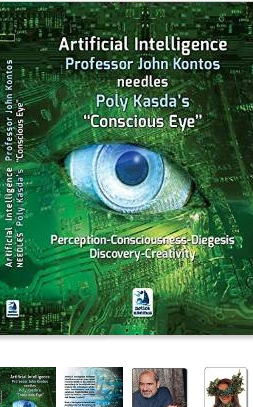
Artificial Intelligence Professor John Kontos "needles" Poly Kasda's Conscious Eye excerpt from the preface


Customer Review by Dr David Gamez

Customer Reviews
By Amazon Customer on March 24, 2016
Kasda's Conscious Eye is an engrossing discussion of the move towards cognitive content in art. Kontos 'needles' key paragraphs of Kasda's text with discussions of contemporary work in artificial intelligence.

Well worth a read if you want to find out more about art, artificial intelligence and the relationship between them.


ARTIFICIAL INTELLIGENCE PROFESSOR JOHN KONTOS NEEDLES POLY KASDA'S CONSCIOUS EYE.
Excerpt from THE PREFACE

The present book is the result of a joint project of Artificial Intelligence Prof. John Kontos and international artist and author Poly Kasda. It offers a guide to recent scientific and technological literature for a number of topics mentioned in Kasda's older book The Conscious Eye (Aigokeros ed. Athens 1988). The present book could be useful for students in the fields of A. I., Art and Psychology.
Kasda's book, subtitled Perception-Art-Informatics was based on her insight into the introspective state of mind of 20thc. artists as they shifted their attention from the object of art to the function of their own mind. Her thesis was partly supported by references to the then rising technology of A. I. as a tool of introspection. 
In the present book, Prof. John Kontos who had written an introductory note to the first edition of The Conscious Eye is rejuvenating this old, but still young text, by lifting it with a set of 'needlings';  injections  that connect it with recent studies in the field of A.I. and particularly of Machine Consciousness; a technology inspired by human consciousness and introspection leading to the implementation of what he calls "autoendoscopic "systems..

Kontos' Needles are gathered in part A  and an English adaptation of  Poly Kasda's The Conscious Eye is in part B. 


CONTENTS:
Preface and Introduction by John Kontos
Twixt the cup and the lip. Introduction by Poly Kasda
Part A Needles by John Kontos
1. Artificial Intelligence 2. The Turing Test 3. Introspection,"Machine Consciousness" and "Autoendoscopic Systems" 4. Gestalt 5. Conceptual Maps 6. The Chair
7. Artificial Vision in Technology and Art 8. Sartre's La Nausee 9. Tinkering 10.Metaphor 11.Metacognitive Instruction 12. Creativity 13. Artificial or Computational Creativity 14. Computational Scientific Discovery and Innovation
15.Computational Creativity in Poetry, Art and Music 16. Automatic Analysis of Diegesis 17. Automatic Synthesis of Diegesis
Part B The Conscious Eye by Poly Kasda
Twixt the lip and the cup epilogue by Poly Kasda
Joint Epilogue by Poly Kasda and John Kontos
CV of P. Kasda and CV of J. Kontos 

What others say:
“Kontos joined forces with Poly Kasda, an artist who studied “the self-combustive frenzy of 20th century art.” Her 1985 booklet, “The Conscious Eye,” foresaw developments in artificial intelligence. Kasda noticed painters in the twentieth century were obsessed with introspection: paying more attention to the workings of their minds than the products of their art. Introspection was also in the background of the rising computer programs in artificial intelligence. So Kontos grasped the ingenuity of Kasda and expanded it into this broad understanding of what artificial intelligence is all about.
Kontos included a translation from the Greek of Kasda’s the “Conscious Eye” into this book, one text seeding and illuminating the other. Indeed, Kontos updates and rejuvenates the insights of Kasda, and, in this innovation, creates an exciting, timely, refreshing, and fascinating history of artificial intelligence - of what it could have become.

I recommend Kontos’ and Kasda’s book. It is a timely, sophisticated, philosophical, and honest account of artificial intelligence, a problematic endeavor of great potential and grave risk”. Evaggelos Vallianatos, Computer engineering and propaganda/the Huffington Post, US. 11/15/2016

5.8.15

Rencontre avec les illustrateurs de Among the Stars !


Rencontre avec les illustrateurs de Among the Stars !

Lorsque je découvre le jeu de cartes Among The stars, je tombe tout de suite sous le charme de l’univers du jeu et les belles illustrations n’y sont pas étrangères. Après quelques parties enthousiasmantes, j’ai pensé que le jeu était trop méconnu dans nos contrées et qu’il méritait donc un coup de projecteur en réalisant sa présentation à travers un Just Played.
Durant cet exercice, je me suis intéressé de plus près au design graphique du jeu et j’ai ainsi atterri sur les blogs de chacun des deux illustrateurs, Odysseas Stamoglou et Antonis Papantoniou. Ils m’ont vraiment bluffé par la qualité de leur travail graphique que j’ai souhaité mieux comprendre et mettre en valeur dans un nouvel article spécifique, curieux de connaître leurs influences.
cards
L’idée d’une interview croisée de chacun d’entre eux a pris forme au fil d’échanges mail sympathiques, et ils ont tous les deux gentiment accepté de m’accorder un peu de temps dans leur agenda surchargé (c’est qu’ils sont tous les deux bien pris en illustrant actuellement plusieurs jeux). Ils répondent donc chacun de leur côté aux mêmes questions.
Je partage ainsi la présentation des deux illustrateurs de Among The Stars sous la forme d’une interview dans laquelle vous en apprendrez un peu plus sur leur parcours d’illustrateur, leurs techniques graphiques et leurs sources d’inspiration.
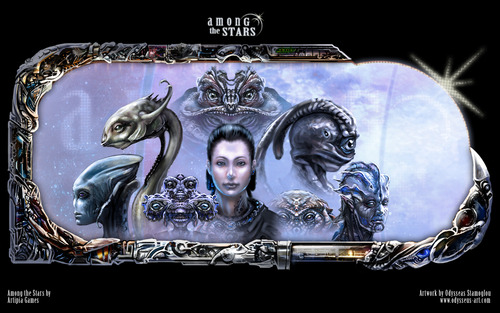
Odysseas Stamoglou et Antonis Papantoniou ont coopéré de façon étroite avec également l’auteur et les autres développeurs de la saga pour réussir à créer un univers futuriste original aux couleurs flamboyantes et de toute beauté.
En fin d’article se trouve un clin d’œil inévitable sur l’historique du jeu par son auteur lui-même, Vangelis Bagiartakis, qui en dévoilant l’origine du jeu devrait vous surprendre…
INTERVIEW D'ANTONIS PAPANTONIOU
banner Antonis 900p300
Personal PhotoBonjour Antonis, pourrais-tu te présenter en quelques mots ?
Je m’appelle Antonis Papantoniou et suis un illustrateur pour jeux vivant à Athènes en Grèce. Bien que j’aie étudié la peinture traditionnelle, je prends plaisir à apprendre les nouvelles technologies et les appliquer dans mon processus d’illustration.

Est-ce que tu dessines exclusivement dans le cadre professionnel ou plutôt loisir ?
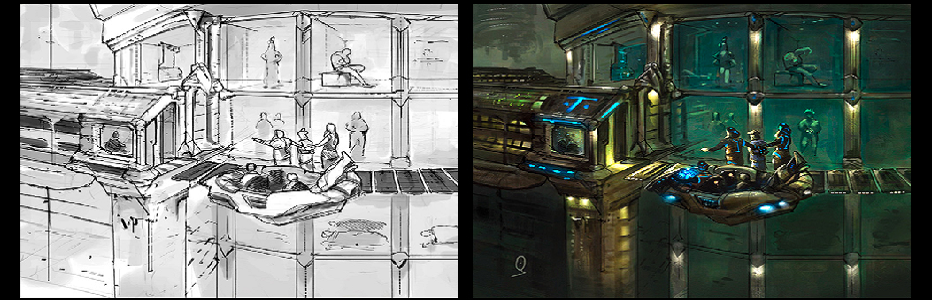
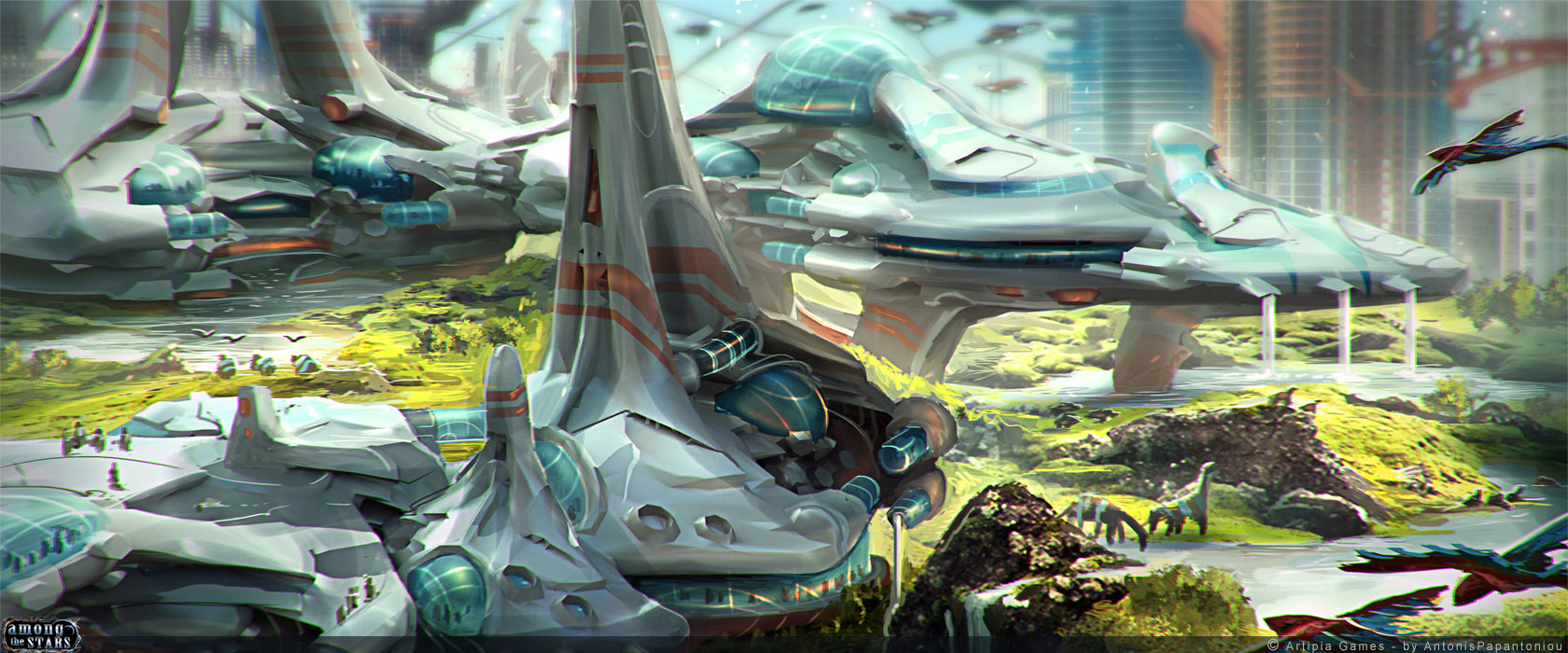
008-AMONG-the-STARS_905Je crée les graphismes pour des jeux de plateau et des jeux vidéos de façon professionnelle. « Dessiner » n’est pas le terme exact, puisque ma méthode de création d’images implique pas mal de sculpture et de modélisation 3D.
En gros, je suis un infographiste professionnel. Je réalise des graphismes exclusivement pour le monde des jeux depuis 2008.

Quels thèmes aimes-tu aborder dans ton travail d’illustrateur ?
 Enfant, j’étais beaucoup influencé par les jeux de rôle, les BD de super-héros, la mythologie ainsi que les jeux vidéos et films de science-fiction. Cette passion m’a motivé pour étudier en premier lieu les illustrations. Donc j’ai réellement adoré travailler dans les thème fantasy et SF. Mais j’apprécie aussi énormément les arts martiaux. Mon thème favori serait donc celui qui parviendrait à combiner le fantasy, la science-fiction et le kung-fu.

Est-ce que tu t’inspires d’autres illustrateurs et as-tu un artiste modèle ?
La liste des artistes qui m’inspirent grandit tous les jours. Je suis plus d’une centaine d’artistes à travers divers forums comme : Feng Zhu, Ben Mauro, Joe Madureira, Naiades, Marco Djurdjevic, Kekai Kotaki, Aleksi Briclot, Sandara, Stanley Lau, Svetlin Velinov, Lius Lasahido, Ludovic Mouliere, pour n’en citer que quelques uns !
Quelques artistes qui m’inspirent sont aussi un modèle pour mon parcours artistique grâce à leur créativité, leur innovation, leur étique de travail et le partage de leur connaissances. Les deux artistes que j’admire le plus et considère comme modèles sont Scott Robertson et Feng Zhu.

pic979376_mdComment es-tu entré dans le monde des jeux de société ? Quels ont été tes premiers projets dans ce domaine ?
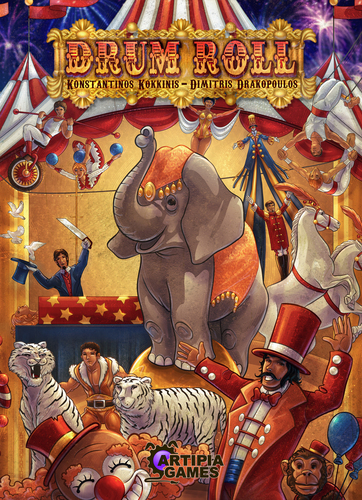
Je suis rentré initialement dans le monde des jeux de plateau en tant que joueur passionné. Comme toute chose pour laquelle je me passionne, cet engouement s’est invité dans mon domaine artistique et j’ai alors commencé à créer mes propres graphismes customisés pour les jeux auxquels je jouais. C’est durant cette période que K. Kokkinis, fondateur de Artipia Games, a conçu son premier jeu, DrumRoll, me demandant de l’illustrer.
Le jeu est devenu populaire à Essen 2011 en élargissant ma vision en tant qu’illustrateur de jeux et m’apportant de nouveaux clients. Mon travail graphique sur DrumRoll a été clairement mon ticket d’entrée en tant qu’illustrateur professionnel dans le monde des jeux de société.

Quels ont été tes projets graphiques avant Among The Stars ?
DrumRoll fut mon premier projet qui a été suivi par Briefcase (Artipia Games), et Fallen City of Karez (Golden Egg Games). J’ai aussi illustré Archon et Shadows over the Empire juste avant mon travail graphique pour l’univers de Among The Stars.

011-AMONG-the-STARS_905Comment es-tu entré dans le projet ATS et quelles sont tes relations avec l’éditeur Artipia Games ?
Mes relations avec Artipia Games sont un peu spéciales puisque le patron, Konstantinos Kokkinis, est aussi mon meilleur ami. Il connaissait ma passion pour les graphismes de science-fiction et comme il était satisfait de mes travaux sur Drumroll et Archon, réaliser les illustrations d’ATS était la suite logique.

Quel a été ton sentiment quand tu as découvert les mécanismes et l’univers du jeu pour la première fois ?
 Je pense qu’ATS possède une mécanique géniale dans un thème fort. Incarner un alien et dessiner des stations modulaires spatiales m’ont super enthousiasmé. J’ai vraiment adoré le développement visuel de cet univers par sa liberté de représentation, la variété des personnages, des environnements et de la technologie qu’il déploie.

Comment as-tu créé l’univers graphique d’ATS ? T’es-tu inspiré d’autres œuvres existantes de SF (livre, BD, film…) ?
ATS représente un vaste univers pourvu de plein d’influences SF. Évidemment, le développement visuel est en partie influencé par Star Wars mais la principale influence pour mes graphismes provient de la BD Sillage de Jean-David Morvan et Philippe Buchet. Celle-ci met en scène une grande variété de races aliens formant un convoi spatial à la recherche de technologie et de ressources…
sillage
Comment vous êtes-vous réparti le travail graphique avec Odysseas ? Comment s’est déroulée ta coopération avec lui et les autres concepteurs du jeu  ?
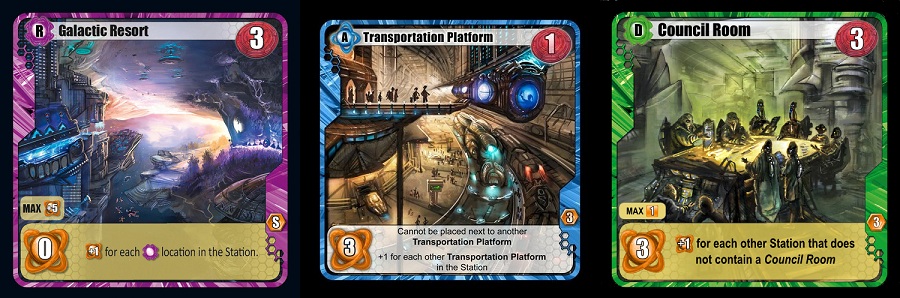
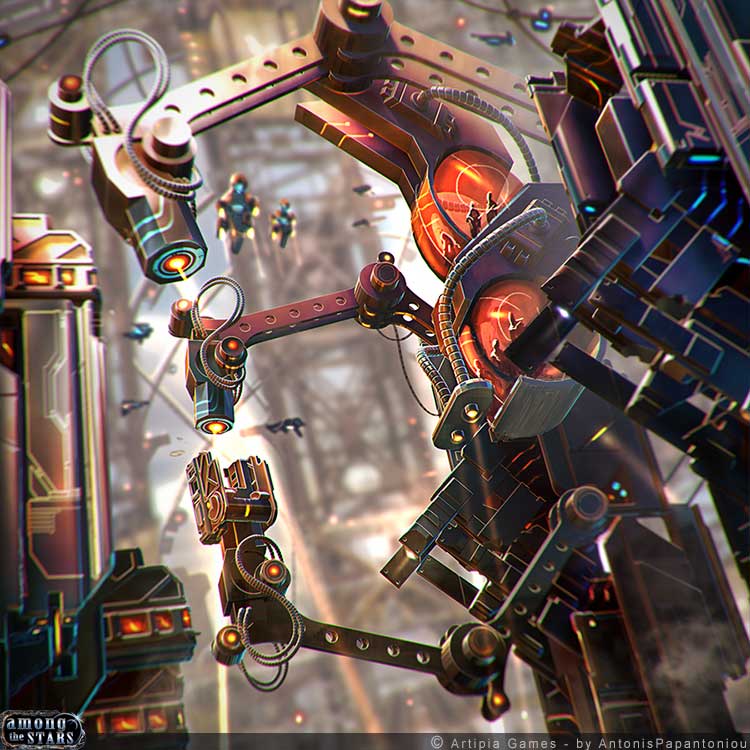
Le projet ATS dépeint beaucoup de peuples et technologie alien. La première étape fut de créer un aspect visuel spécifique pour chaque race aux caractéristiques physiques et technologiques diverses. Ce processus de conception a engendré une librairie de dessins utilisables pour le design des cartes. Pour les races, le concept général a été créé par Odysseas. Puis j’ai repris les croquis en réinterprétant les peuples alien afin de constituer leurs multiples illustrations finales. Pour les stations spatiales et les technologies alien, Odysseas et moi avons travaillé sur les mêmes paramètres mais en utilisant des processus différents pour aboutir aux illustrations finales. Son style est le dessin classique tandis que le mien inclut de la sculpture 3D, de la modélisation et de superposition d’images.
001-Alliance-High-Coulcil_905
Pourrais-tu expliquer comment tu as créé l’univers d’ATS ? Quel a été le processus de dessin et les outils que tu as utilisés ?
Le travail graphique sur ATS est énorme. Cela signifie que j’ai dû créer plus de cent illustrations de cartes. Donc la première étape fut de concevoir une bibliothèque d’éléments 3D qui pouvaient être recyclés et réutilisés tout au long du projet.
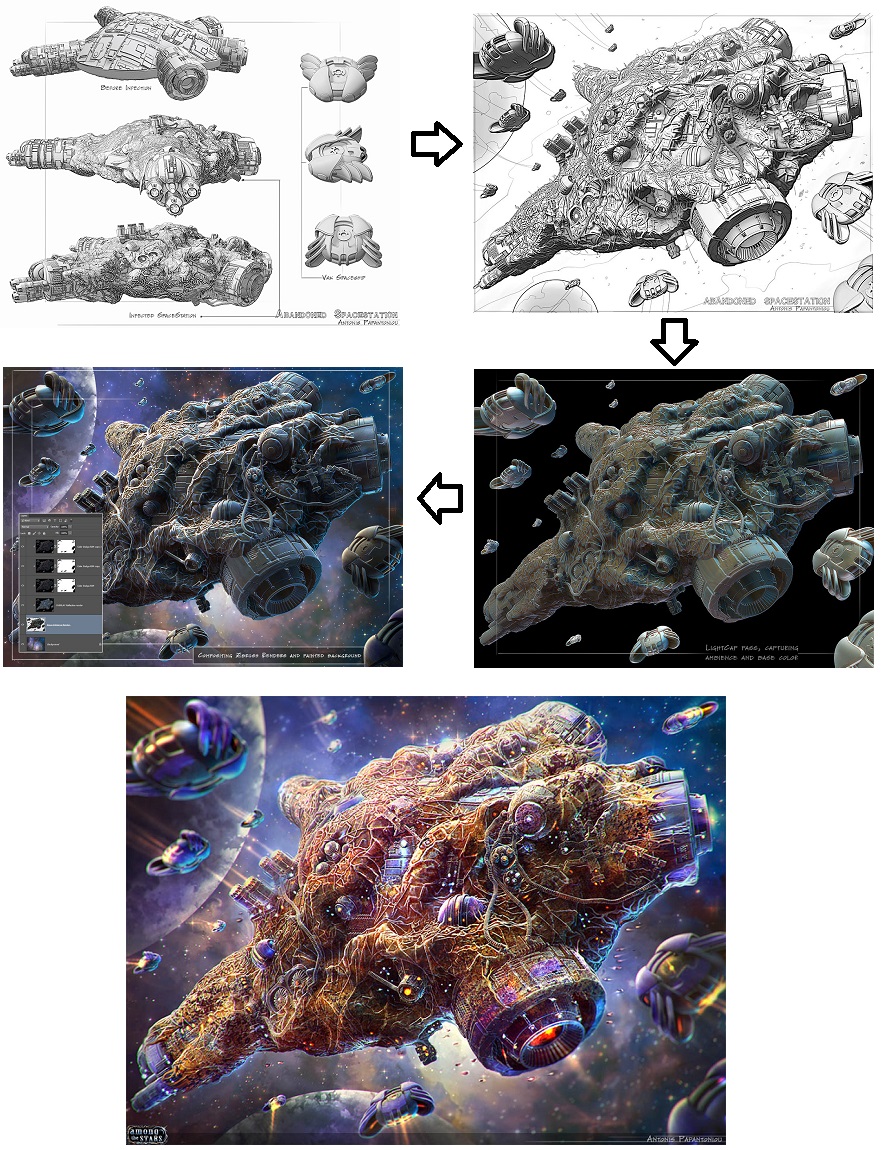
Ces éléments sont constitués d’architectures futuristes, de vaisseaux, de dessins d’alien, de machines, etc… J’ai créé toutes ces images dans un logiciel 3D, Zbrush . J’ai ensuite utilisé tous ces éléments pour composer des scènes élargies.
Process all
Quand une composition 3D était effectuée, je l’envoyais à Konstantinos sous Skype pour approbation.
L’étape suivante était la lumière et la mise en scène dans Zbrush. Puis j’utilisais le rendu de l’image comme base pour la coloriser dans Photoshop.

Si tu devais conserver une seule illustration conçue pour ATS, celle dont tu es la plus fière : laquelle choisirais-tu ?
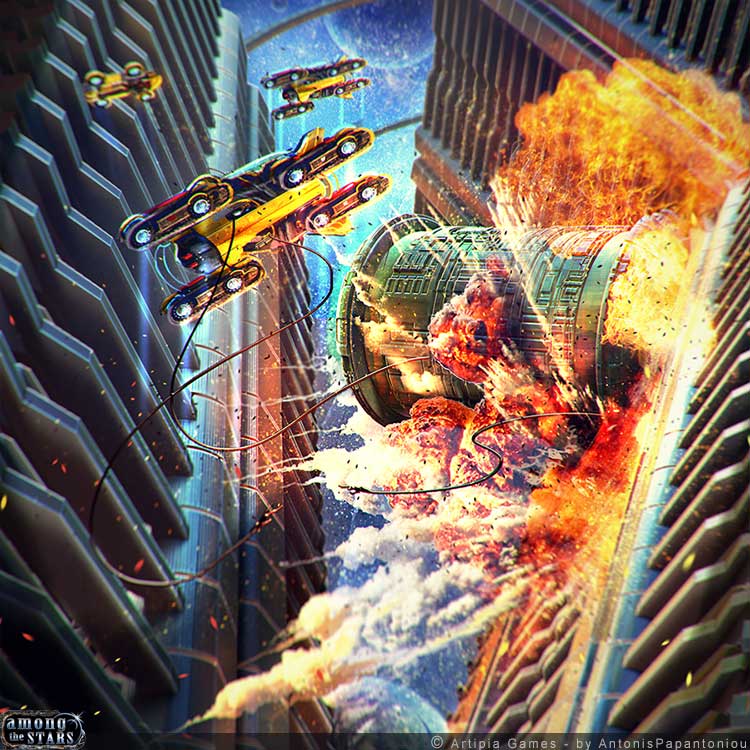
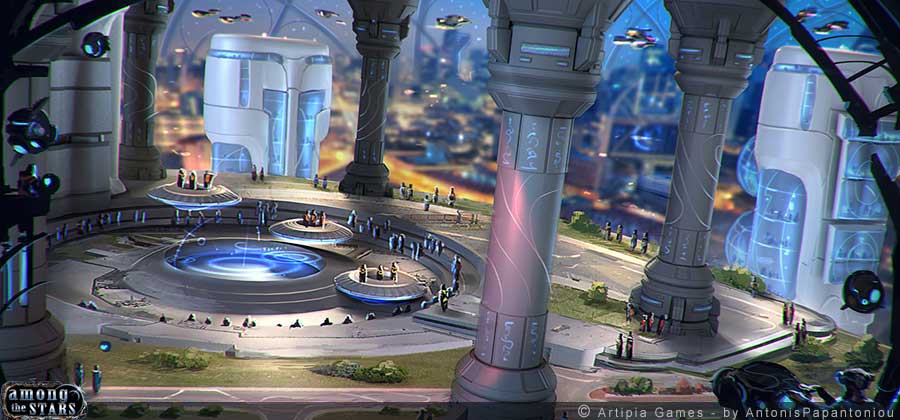
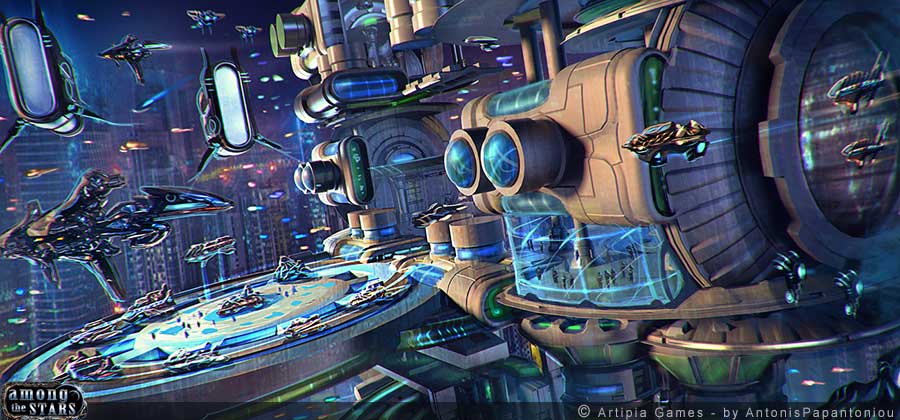
 J’aime la plupart des illustrations du jeu mais si je devais en mettre en avant une serait la double carte « environnement artificiel » ci-dessous.
Favorite Image
Quelles ont été tes premières impressions quand tu as reçu les éléments matériels finaux du jeu ? As-tu déjà joué au jeu ?
J’étais ravi de recevoir le produit final. Je trouve d’ailleurs que mes illustrations ont un bien meilleur rendu graphique sur les cartes que sur l’écran de mon ordinateur. ATS est l’un de mes jeux favoris auquel je joue beaucoup, mais pas avec mon exemplaire que je conserve comme une pièce unique de mon portfolio :)

Es-tu également un joueur de cartes ou jeu de plateau ? Quels sont tes jeux favoris ?
Je suis un grand fan de jeux de société ! Je joue aux jeux de plateau depuis l’école élémentaire et je n’ai jamais arrêté.
Les jeux de carte comme Magic : l’assemblée ont eu un fort impact sur moi et m’ont donné l’inspiration de suivre une carrière dans la voie d’illustrateur de jeux.
J’ai plein de jeux favoris mais mes goûts ludiques sont souvent biaisés par l’attirance de leur côté graphique. Cela signifie que si l’aspect graphique d’un jeu m’attire, il rentre directement dans ma liste préférentielle même si les mécanismes de jeu sont mauvais.
Voici la liste de certains de mes jeux favoris (hormis ceux que j’ai illustrés) : Summoner Wars, Star Realms, King of Tokyo, Cyclades (avec l’extension Hadès ou Titan) et Rencontre Cosmique.

Quels sont les projets sur lesquels tu travailles actuellement et dans les prochains mois ?
ALIENS-001_900
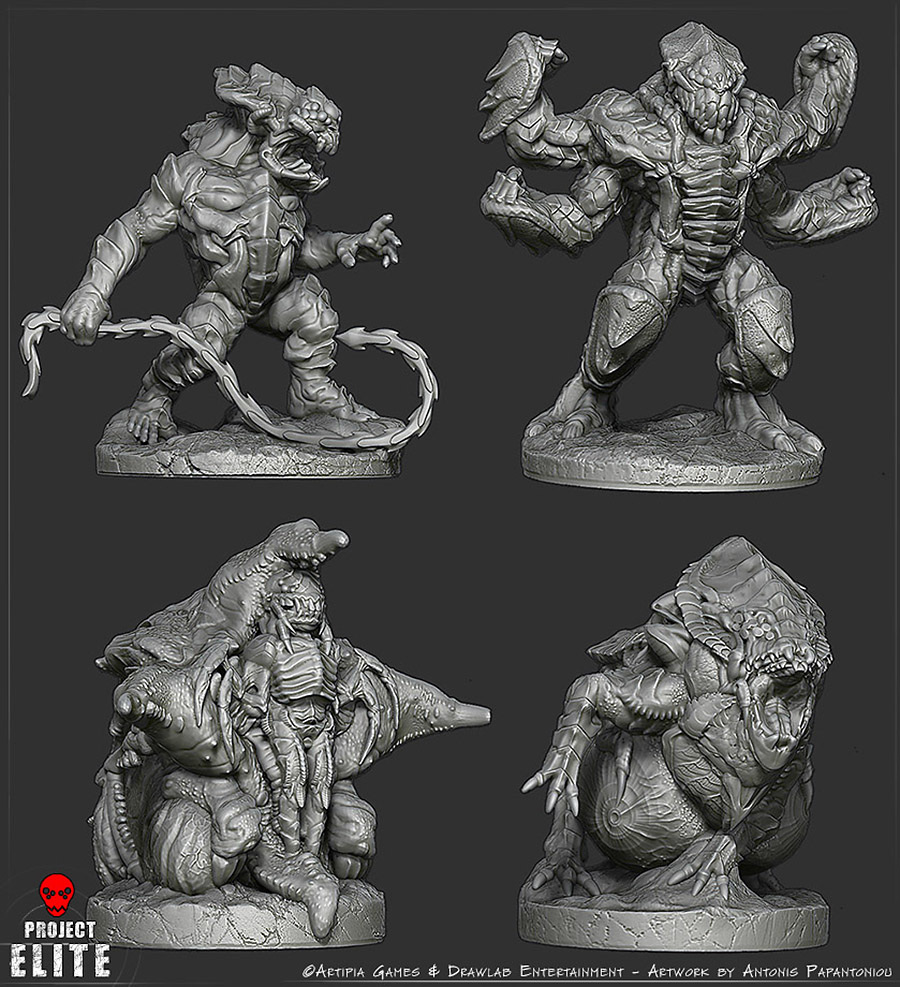
Je travaille actuellement sur deux projets très prenants. Le premier est un jeu de plateau de miniature intitulé Project: Elite chez Artipia Games et DrawLab Entertainment dans lequel j’effectue les sculptures de tous les soldats des créatures alien et des humains.
Ce jeu est très dynamique et vivant, et je suis certain qu’il deviendra un gros succès de 2015-2016.
Plus d’infos sur le projet via la fiche du jeu ou le site de lancement Kickstarter dont la campagne s’est achevée il y a quelques mois.

MURDEROUS-NECROMANCER_900 EPIC
Epic : le nécromancien
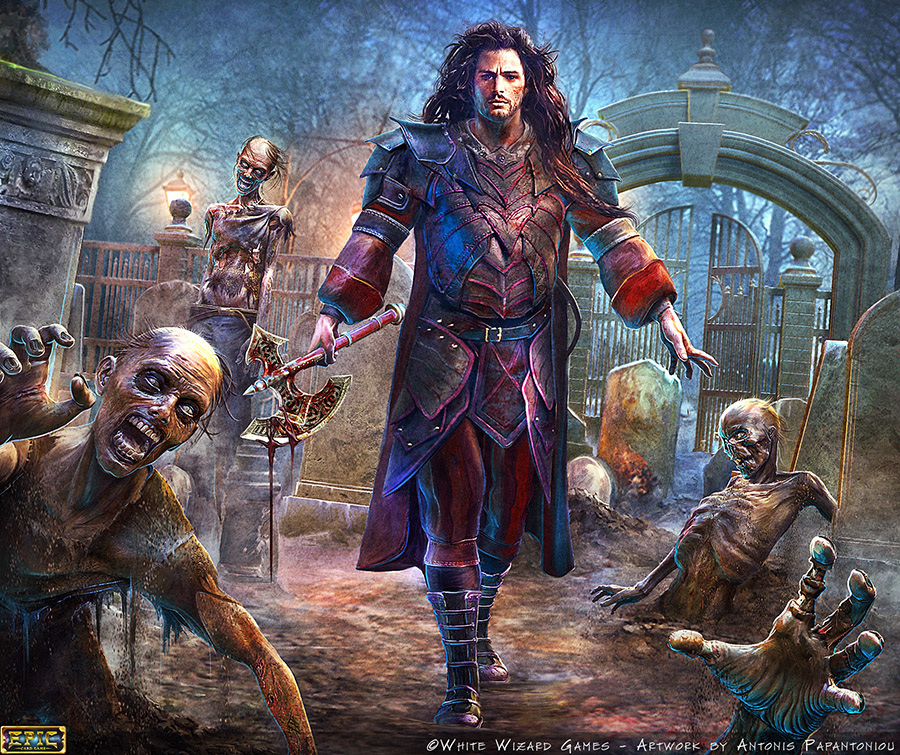
L’autre projet concerne un jeu de carte intitulé Epic, par les auteurs de  Star Realms et édité chez White Wizard Games dans lequel je réalise un travail d’illustrateur.
Il s’agit d’un jeu de cartes dans un univers type fantasy et je crois aussi qu’il sera très plébiscité pour le prochain salon d’Essen. Plus d’infos sur le projet via la fiche du jeu ou le site de lancement Kickstarter dont la campagne s’est achevée en Mai 2015.
Où peut-on trouver un résumé de tes travaux sur la toile ?
Plus d’infos concernant mon travail graphique est consultable sur mon blog et mon compte FB.
Merci Antonis pour cet interview !
A noter que le blog d’Antonis comporte une section très intéressante décrivant en détails et de façon illustrée la création d’une illustration, étapes par étapes.

LE MOT DE LA FIN

Le travail des deux illustrateurs a donc été colossal et de qualité pour enrichir le jeu et ses nombreuses extensions, sans compter le stand-alone qui reprend le même univers : New Dawn.
003-b-spaceport_905
A travers leur interview décrivant leurs techniques de dessin et leur production, on se rend bien compte que le style graphique est différent pour les deux illustrateurs : Odysseas réalise des illustrations plus épurées alors que celles d’Antonis sont plus détaillées, un complément qui apporte de la diversité aux nombreuses cartes du jeu. Leur points communs sont nombreux : ils sont tous les deux passionnés par le thème SF et se sont focalisés dans le but de servir l’univers SF du jeu de la manière la plus réaliste et cohérente possible.
among the stras
Le style graphique des illustrateurs est d’ailleurs maintenant très reconnaissable du premier coup d’œil à la pochette d’autres jeux passés (Drumroll, Archon, Versailles…) ou à venir (Epic, Project: Elite), à l’instar d’autres illustrateurs de renom : Michael Menzel (Andor, Bruges, Cuba, L’age de pierre), Dennis Lohausen (Descendance, El Gaucho, Les voyages de Marco Polo), Pierô (Ghost Stories, Mr Jack, Dice Town) ou encore Vincent Dutrait (Augustus, Lewis & Clark, New York 1901,Discoveries) pour ne citer qu’eux quatre dont l’excellent travail graphique mériterait bien aussi un coup de projecteur…
pic1545796_md
On parle beaucoup en ce moment de la faillite du système économique grecque et cela fait du bien d’évoquer des éléments positifs de ce pays, actif du côté des auteurs et des illustrateurs de jeux, avec en fer de lance l’éditeur Artipia Games qui propose toujours des nouveautés intéressantes.
Souhaitons leurs le succès pour les futurs jeux sur lesquels travaillent Odysseas et Antonis et qu’ils continuent à nous transporter dans des mondes parallèles imaginaires à travers leurs belles illustrations…

26.7.15

Artificial Intelligence Prof. needles The Conscious Eye ( a short chronicle by Poly Kasda).


..


Artificial Intelligence Prof. John Kontos “Needles” Poly Kasda’s Conscious Eye.
Perception-Consciousness-Diegesis-Discovery-Creativity


"What was the nature of this compulsive tide that pushed XXc. artists in a self-cancellation frenzy, leaving behind a dilapidated mental space and the labyrinthine traces of an unsatiated question mark?

 This was the question I was persistently raising throughout The Conscious Eye, Aigokeros 1988, a cross-disciplinary essay dealing with an eye that sees itself seeing, that thinks itself thinking, as it undergoes the crisis of self- consciousness that sealed the arts and sciences of the 20thc; an introspective attitude which revealed the linguistic-cognitive scaffold of vision and triggered modern crisis, mining with autognostic explosives our certainties; a cognitive revolution that shifted our attention from behavioral phenomena to their inner mechanisms.

In that book i had made several references to the then rising science of A.I. as an introspective, philosophical tool, which, by externalizing the mechanistic aspects of our thinking helps us realize other ways of thinking; an obsession that drove me to anchor my insight on the then (1985) ongoing academic research applications in Prof. Seymour Papert’s  A.I. department at the MIT. 

My research was documented in my narrative documentary The Adventures of the Eye, with documentarist Marco Gastine for the Greek national TV 1986. During the shootings, I met A.I.Prof. John Kontos who foreworded my essay The Conscious Eye, Perception-Art-Informatics that followed the documentary.

Two years ago, after the lapse of a quarter of a century, Dr. John Kontos asked me to translate The Conscious Eye in English since he wished to ‘needle’ my old text with fresh information from the recent research developments in the field of Artificial Intelligence, Machine Consciousness and creativity, during the elapsing 25 years.

 A chunk or two years heavy with endless discussions on the nature of Intelligence and Consciousness followed this call. It resulted in the publication of our English book: Artificial Intelligence Prof. John Kontos “Needles” Poly Kasda’s Conscious Eye, southwind/notiosanemos ed.2015.

In the meantime I started writing a narrative chronicle revealing the psychic experience underlying and sustaining my own self-combustive project Myth/Network during this elapsing chunk of 25 years:  a self-reflexive speculation that resulted in the publication of my allegoric narrative When that Word swallowed me. Its protagonist is Alfie “the perpetual resident of chaos”; a real persona with transcendental coordinates…".
PolyXene Kasda 


Both books Artificial Intelligence Prof. John Kontos “Needles” Poly Kasda’s Conscious Eye and When that Word swallowed me were presented in the Stoa tou Vivliou Athens 2.6.2016
Nέα έκδοση από το "Νότιο Άνεμο" για τη σχέση τεχνητής νοημοσύνης & τέχνης - ert.gr

Commentators:
Dr. Harry Meletis, cybernetics researcher
Dr. Manthos Santorinaios, Prof. Athens’School of Fine arts, director of the Master in Artificial Intelligence and Art department.
Dr. Peter Tzelepidis, cognitive sciences professor
Dr. Yannis Almyrandis, Democritos research institute of biosciences and applications director.

Mariana Zikou, art-historian

"In her essay The Conscious Eye she describes the consistent path of art, through the changes of the innner visual processes, before its breaking up into a chaotic process of many trends and structures that define our times.
I wonder whether we should catch the line from this point on; the path through the concepts, the analysis of language and the contemporary mechanisms of its processing and the esoteric vision which her book projects as the record of an adventure”.
Dr. Manthos Santorinaios, Athens School of Fine Arts Professor, 2/6 Stoa tou Vivliou  Athens  

" she manages with a pre-scientific  way’ Paracelsus, Leonardo’s , the witch-doctor’s and Huomo Universalis’ to connect the tangible with the intangible and to  manifest in front of our eyes invisible dynamic lines that lend to our world a little more meaning"
Dr. Yannis Almyrandis, Democritus institute of bioscience and applications EKEFE, Over-determination in poly kasda’s work, 2/6 stoa tou vivliou Athens  

"..intriguing artistic text… I take it as the other side of the mind from which the Conscious Eye emerged; a structured epistemological discourse that surfaced through that same impressive imaginary which reveals itself consistently over the artistic course of a lifetime. It is great it revealed itself once more in the form of this text.
Thoughts that are hard to embed as language, thoughts and images that reside submerged within us, that we ourselves do not know what they mean, what needs they meet and in which unknown territories they game us to.
Perhaps this narrative is a call to see, to reify the uncharted, terrible and unrecognizable dimensions of our human and non-human(?) imaginary.
The Conscious Eye continues its search and investigation in the most elusive, controversial, intra-real dimensions of its existence"
. 
Mariana Zikou, Art-historian, introduction to P.Kasda's allegorical narrative "when that word swallowed me". 

“Kontos joined forces with Poly Kasda, an artist who studied “the self-combustive frenzy of 20th century art.” Her 1985 booklet, “The Conscious Eye,” foresaw developments in artificial intelligence. Kasda noticed painters in the twentieth century were obsessed with introspection: paying more attention to the workings of their minds than the products of their art. Introspection was also in the background of the rising computer programs in artificial intelligence. So Kontos grasped the ingenuity of Kasda and expanded it into this broad understanding of what artificial intelligence is all about.
Kontos included a translation from the Greek of Kasda’s the “Conscious Eye” into this book, one text seeding and illuminating the other. Indeed, Kontos updates and rejuvenates the insights of Kasda, and, in this innovation, creates an exciting, timely, refreshing, and fascinating history of artificial intelligence - of what it could have become.
I recommend Kontos’ and Kasda’s book. It is a timely, sophisticated, philosophical, and honest account of artificial intelligence, a problematic endeavor of great potential and grave risk”. Evaggelos Vallianatos, Computer engineering and propaganda/the Huffington Post, US. 11/15/2016

Customer Review by Dr David Gamez


Customer Reviews

By Amazon Customer on March 24, 2016
Kasda's Conscious Eye is an engrossing discussion of the move towards cognitive content in art. Kontos 'needles' key paragraphs of Kasda's text with discussions of contemporary work in artificial intelligence.

Well worth a read if you want to find out more about art, artificial intelligence and the relationship between them.

25.7.15

Η μυθική Σφίγγα θέτει ξανά το ερώτημά της

Η μυθική Σφίγγα θέτει ξανά το ερώτημά της

Στο Διεθνές Φεστιβάλ των Κρυμμένων Θηβών «Σφίγγα 2015»
Κυριακή, 26 Ιουλίου 2015 07:30


Μια νεοελληνική παραμελημένη πόλη, η οποία διαθέτει μια μακρά ιστορία και ένα μεγάλο διαχρονικό πολιτισμικό απόθεμα: ιστορία, μύθους, πολιτισμό, η Θήβα, δημιουργεί μια φιλόδοξη καλλιτεχνική πρόταση για τη θεμελίωση της ταυτότητας μιας νέας πόλης, μέσα από το Διεθνές Φεστιβάλ των Κρυμμένων Θηβών «Σφίγγα 2015».

Πρόκειται για ένα διεθνές θεματικό καλλιτεχνικό project, στον αστικό και κοινωνικό χώρο της Θήβας, με πολλαπλές δράσεις εικαστικών, θεάτρου, μουσικής, αρχιτεκτονικής και χορού, οι οποίες πραγματοποιούνται σε διαφορετικούς και ειδικά επιλεγμένους, χώρους της πόλης.


Αρχαίο αίνιγμα, στη σύγχρονη εκδοχή του

Με κεντρικό θέμα το αίνιγμα που έθετε η αρχαία Σφίγγα στον Οιδίποδα: «Τί ἐστιν ὅ μίαν ἔχον φωνὴν τετράπουν καὶ δίπουν καὶ τρίπουν γίνεται;», στη σύγχρονη εκδοχή του, δημιουργοί από όλο το φάσμα των τεχνών, θα επιχειρήσουν μια βύθιση στον τόπο και τον χρόνο, προκειμένου να επαναπροσδιορίσουν το νόημα του σημερινού ανθρώπου. Καλλιτέχνες από όλον τον κόσμο, επιστήμονες, φοιτητές, μαθητές και κοινό, θα συνυπάρξουν, μέσα από τη «Σφίγγα 2015», με τα μνημειακά και μνημονικά στοιχεία της πόλης, αναζητώντας - μέσα από τις δημιουργίες και τις δράσεις τους - την αθέατη Θήβα, ως λύση πολιτισμού, η οποία θα οδηγήσει, πιθανόν, σε μια νέα ταυτότητα του χώρου και των ανθρώπων που την κατοικούν. Μέσα στον πραγματικό, αλλά και εικονικό ιστό της πόλης (διαδίκτυο), καλλιτέχνες και πολίτες δημιουργούν, πραγματοποιούν πολλαπλά καλλιτεχνικά, πολιτιστικά ή απλώς κοινωνικά δρώμενα, και καταθέτουν έργα - προτάσεις, πράξεις πολιτισμού.


Τα έργα - προτάσεις θα επιχειρήσουν να ανατρέψουν την ακινησία, τον εφησυχασμό και την αδράνεια - στοιχεία σήψης στο παρόν - και να ενώσουν τις δράσεις των ανήσυχων πολιτών, προσδοκώντας μια αλλαγή στο μέλλον της πόλης.


Ένα πείραμα για τη Θήβα

Θέμα του πειράματος της Θήβας είναι η αναζήτηση τρόπων, μέσα από τους οποίους μια ολόκληρη πόλη μπορεί να γίνει τόπος πειραματισμού, διατυπώνοντας ουσιαστικές θέσεις και απαντώντας αληθινά στα προβλήματα των καιρών της παγκόσμιας οικονομικής, πολιτικής, κοινωνικής, ηθικής και γνωστικής κρίσης. Η αρχαία Θήβα αποδεικνύεται ο ιδανικός χώρος για την πραγματοποίηση ενός πειράματος, που θα οδηγούσε σε έναν επαναπροσδιορισμό της σύγχρονης πόλης, κινητοποιώντας τον μύθο και την ιστορία που την ακολουθούν, προς όφελος της δημιουργίας και της ανάδειξης μιας νέας ταυτότητας.

Η αλλαγή επιδιώκεται μέσα από τον σχεδιασμό αυτόνομων δημιουργικών προτάσεων, με τη συμμετοχή καλλιτεχνών, αλλά και πολιτών από τον  πραγματικό κοινωνικό ιστό, με στόχο την αλλαγή  στο μέλλον της πόλης. Σε αυτό το εγχείρημα, επιστρέφουμε στη Σφίγγα των Θηβών την απάντηση του Οιδίποδα, με το ερωτηματικό «τι είναι ο άνθρωπος».


Το ερώτημα επανεξετάζει το νόημα του ανθρώπου, μέσα από τη θέση του στην ιστορία: α) το απώτερο παρελθόν, με τις αξίες, τις συγκρούσεις, τον πολιτισμό που δημιούργησε
β) τη σημερινή κοινωνία, τις σύγχρονες προκλήσεις και κοινωνικοοικονομικές συγκρούσεις, τις πολιτισμικές ροές και συγχωνεύσεις (πολιτιστική επέκταση, μετανάστευση), τον ρόλο της τεχνολογίας, της επικοινωνίας και του ίντερνετ, τη δύναμη της εξουσίας, τη γονιδιακή επιστήμη, τις νέες εφαρμογές στον σύγχρονο κόσμο
γ) τις λύσεις και τις προτάσεις για το μέλλον.


Μία νέα οργάνωση Η Σφίγγα είναι μία νέα οργάνωση, αποτελούμενη από εκπροσώπους των εικαστικών, της αρχιτεκτονικής, του θεάτρου και της μουσικής, οι οποίοι ερευνούν διαρκώς την πολυεπίπεδη και ιδιόμορφη περίπτωση της πόλης της Θήβας.


Για το 2015, η οργάνωση Σφίγγα δημιουργεί, οργανώνει και προτείνει το Διεθνές Φεστιβάλ Σφίγγα 2015, με στόχο την ανάδειξη όλων εκείνων των στοιχείων της αθέατης Θήβας, τα οποία θα συνεισφέρουν στη δημιουργικότητα, αλλά και στον  επαναπροσδιορισμό της ταυτότητας της πόλης. Το Φεστιβάλ που ξεκίνησε τον Μάιο και θα διαρκέσει έως τον Δεκέμβριο του 2015 τελεί υπό την Αιγίδα του υπουργείου Παιδείας, Πολιτισμού και Θρησκευμάτων, υπό την αιγίδα και με τη συνεργασία της Ανώτατης Σχολής Καλών Τεχνών και με τη συνεργασία της Θ’ Εφορείας Προϊστορικών και Κλασικών Αρχαιοτήτων Βοιωτίας και του Δήμου Θηβαίων. gkoul@naftemporiki.gr